
Recording: HERE
When: MAY 6th 2026
Time: 8:00 a.m. Mountain Time (MT) / 10:00 a.m. (EDT)
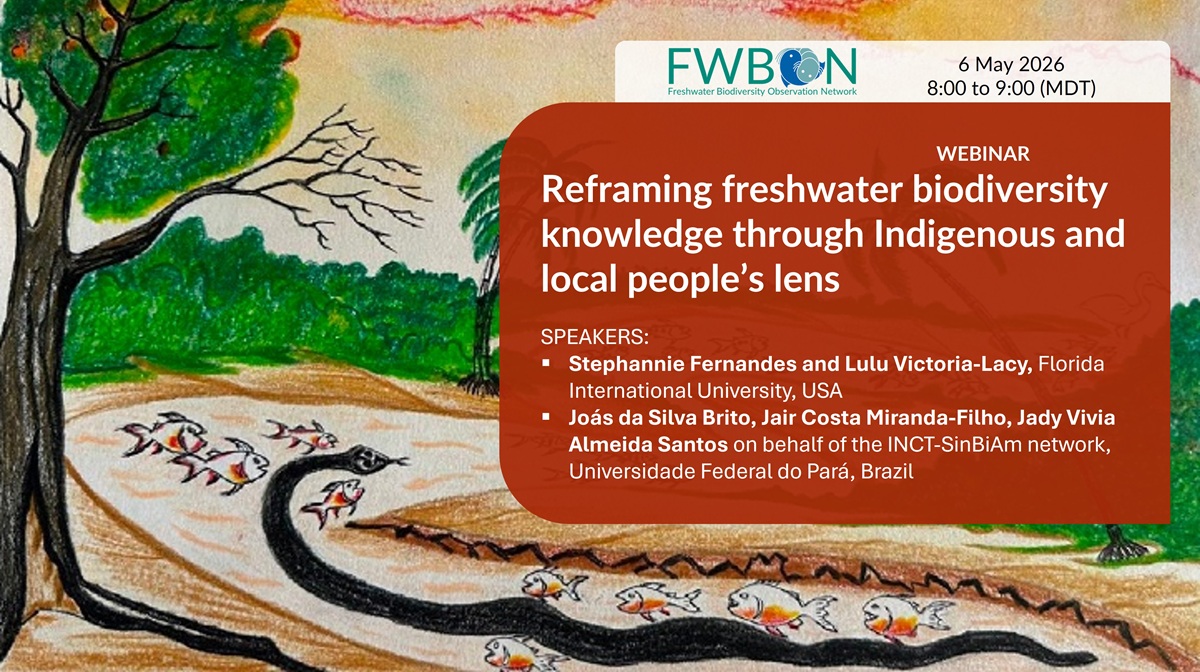
This webinar will explore how freshwater biodiversity knowledge can be reframed through the perspectives of indigenous peoples and local communities, highlighting the importance of social, cultural, and ecological dimensions in understanding and managing aquatic systems.
The webinar will feature case studies from different parts of the world. Stephannie Fernandes will present on Amazonian fish migration, emphasizing how indigenous knowledge reveals migration as a complex social–cultural–ecological process. A team from the Universidade Federal do Pará (UFPA), Brazil, will present on behalf of their networks, the INCT-SinBiAm, PPBio Amazônia Oriental (PPBio AmOr), PELD Amazônia Oriental (PELD AmOr) and Conservation Internation, on collaborative work on freshwater biodiversity knowledge production and participation.
Together, these presentations will showcase how integrating diverse knowledge systems can enrich biodiversity monitoring, inform conservation strategies, and support more inclusive and effective environmental governance.
Agenda
| Time (EDT) | Item |
|---|---|
| 10:00 am | Welcome and introductions |
| 10:02 | FWBON, by Fabio de Oliveira Roque |
| 10:05 | Amazonian fish migration through indigenous knowledge: a social-cultural-ecological process, by Stephannie Fernandes and Lulu Victoria-Lacy |
| 10:25 | Co-producing freshwater biodiversity knowledge with Indigenous Peoples: insights from participatory monitoring in the Panará Indigenous Territory (Brazilian Amazon), by Joás da Silva Brito, Jair Costa Miranda-Filho, Jady Vivia Almeida Santos on behalf of the team and collaborators of INCT-SinBiAm. |
| 10:55 | Wrap-up |
Speakers
Stephannie Fernandes – Florida International University, USA

Stephannie S. Fernandes is a PhD candidate in Geography at Florida International University. With a background in environmental science and law, her research explores the governance of migratory freshwater fish in the Amazon Basin. She focuses on how national and transboundary policies align with the ecological connectivity required by long-distance migratory species. Her work combines policy analysis and movement ecology to better understand conservation challenges across Brazil, Colombia, and Peru.
Lulu Victoria-Lacy – Florida International University, USA

Lulu Victoria-Lacy is an interdisciplinary ecologist and visual artist interested in the connections between tropical ecology and cultural anthropology. As both an artist and researcher, she is interested in co-creative worlds of people and aquatic life. Her methodologies incorporate transdisciplinary and biocultural approaches, working with riparian communities to strengthen local conservation practices with freshwater. Her work has helped to visualize multi-species rhythms and relations in the lake system, and communities document changes in seasonality as a result of climate change and other pressures.
Jady Vivia Almeida Santos – Federal University of Pará (UFPA), Brazil
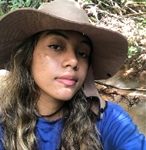
Jady Vivia Almeida Santos is a graduate student at the Federal University of Pará (UFPA), Brazil, working at the Laboratory of Ecology and Conservation (LABECO). Her research focuses on freshwater biodiversity, participatory monitoring, and the co-production of knowledge with Indigenous Peoples in the Amazon. She is actively involved in major research networks, including PPBio AmOr, PELD AmOr, and INCT-SinBiAm.
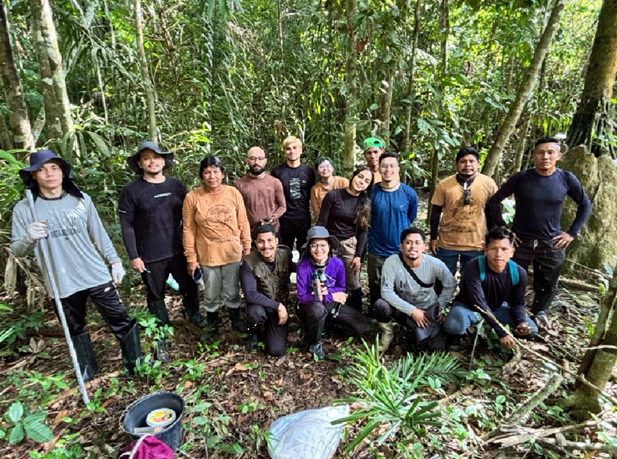
From right to left: Keransã Panara, Sewa Panara, Korakoko Panara, Giovani Gomes, Yan Campioli, Nhasykiat Panara, Jady Santos, Rayssa Carmo, Ana Beatriz Pampolha, Jair Filho, Juan Esteban, Erival Prata, Karapow Panara, Antônio Jardim e Ronald Almeida.
Networks: PPBio Amazônia Oriental (PPBio AmOr), PELD Amazônia Oriental (PELD AmOr), INCT Synthesis of Amazonian Biodiversity (INCT-SinBiAm)