
Recording: HERE
When: OCTOBER 30th 2026
Time: 11:00 – 12:30 UTC
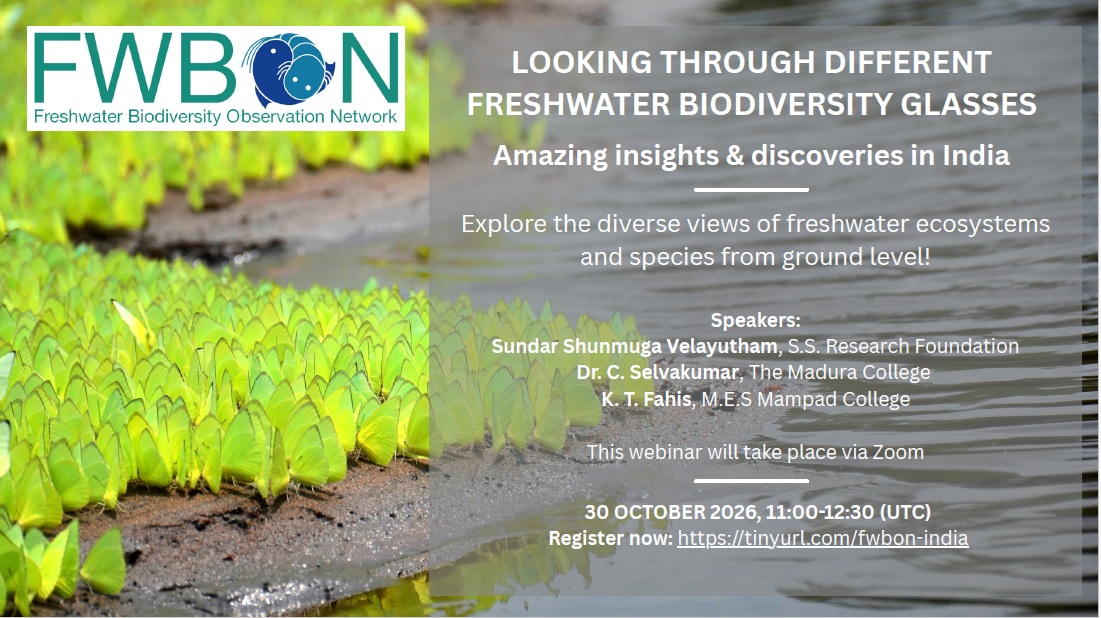
This webinar explores the diverse views of freshwater ecosystems and species from the ground level. Generations of spiritual beliefs, cultural traditions and community stewardship add valuable lessons to all in sustaining these precious resources. At the same time, discoveries and understanding of the small organisms add new values to enrich the spiritual value and meaning of invertebrates too. Mayflies, stoneflies and caddisflies as bioindicators, bridge cultural heritage and ecological integrity in the face of a changing climate. Assessment of dendrotelms reveals immense discoveries in microhabitats that are often overlooked or just passed by.
Agenda
| Time (UTC) | Item |
|---|---|
| 11:00 | Welcome and introduction on FW BON |
| 11:05 | Sacred aquatic sites in South India: cultural values, biodiversity, and conservation challenges, by Sundar Shunmuga Velayutham |
| 11:20 | Diversity of mayflies, stoneflies and caddisflies in the freshwater ecosystems of India, by Dr. C. Selvakumar |
| 11:35 | How do tiny tree-hole ecosystems contribute to the overall biodiversity of the Western Ghats in India? by K. T. Fahis |
| 11:55- 12:30 | Discussion and wrap-up:
Bridging cultural heritage, ecological integrity, and freshwater monitoring in a changing climate The value of monitoring invertebrates, recognition of ephemeral systems; these often overlooked in global and national assessments? |
Speakers
Dr. S. Sundar Shunmuga Velayutham – Senior Scientist, Division of Ecology and Environmental Sciences, S.S. Research Foundation, Tamil Nadu,India

Dr. Sundar is an ecologist with more than two decades of experience in freshwater biodiversity, aquatic insects, and conservation policy. He has been actively involved in national and international collaborations that advance ecological research and conservation practice. His work has established aquatic macroinvertebrates as vital bioindicators and informed strategies for protecting forests, wetlands, and significant aquatic landscapes.
Dr. C. Selvakumar – Assistant Professor, Department of Zoology, The Madura College (Autonomous), Tamil Nadu, India
Dr. Selvakumar is an Assistant Professor and a researcher specializing in mayflies (Order: Ephemeroptera). He is basically interested on the exploring the diversity of aquatic insects in general and mayfly, stonefly and caddisfly in particular. He is actively doing the research on systematics and diversity of Ephemeroptera of India. He has described 30 new species of mayflies and established two new genera of mayflies from India. He developed DNA barcodes for 40 species of mayflies, which help in accurate species identification and genetic studies. His current research focuses on the phylogeny and phylogeography of mayflies in India.
Mr. K. T. Fahis – PhD Candidate Centre for Conservation Ecology and Department of Zoology M.E.S Mampad College (Autonomous – University of Calicut) Malappuram, Kerala, India
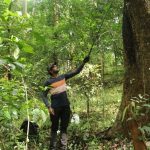
Mr. Fahis is a PhD Candidate working on freshwater biodiversity and aquatic invertebrate ecology with a particular focus on natural water-filled tree holes in a tropical forest of the Western Ghats in India. Over the past years, Fahis has been actively involved in ecological research and taxonomic studies of aquatic and terrestrial invertebrates. He studies how altitude, habitat, and tree hole characteristics influence aquatic invertebrate diversity and community structure, while also comparing natural tree holes with artificial analogues. His research has contributed to documenting the lesser-known biodiversity of the Western Ghats, with publications in reputed international journals. His work includes a first report of gynandromorphy in a freshwater crab and contributions to the description of two new earthworm species. He has also built international research collaborations through fellowships and research visits to institutions in Switzerland and Japan, including SUPSI, WSL, and Kyoto University.