
Move BON is pleased to announce the publication of a new paper in Nature Reviews Biodiversity that highlights the critical role of animal movement in biodiversity monitoring and policy.
The paper, A call to integrate animal movement into biodiversity indicators, argues that information on how animals move through landscapes and seascapes can provide powerful insights into ecosystem connectivity, species responses to environmental change, and the effectiveness of conservation actions. Further, changes in migrations and movement behaviour, often measured in real-time, can reveal ecological disruptions before population declines become apparent.
As countries implement the Kunming-Montreal Global Biodiversity Framework (KMGBF), the authors call for animal movement metrics to be integrated into biodiversity monitoring systems, indicators and policy processes. They highlight the need for widespread coordination of existing efforts and stronger investment in movement observation systems, as well as greater use of movement data to support conservation decision-making in the context of multilateral conservation agreements.
“Move BON is bringing together an incredible community to accomplish the huge, but important, task of translating the wealth of animal movement data now available into actionable conservation policies. It’s exciting to see the power of this collaboration.” – Ruth Oliver, lead author
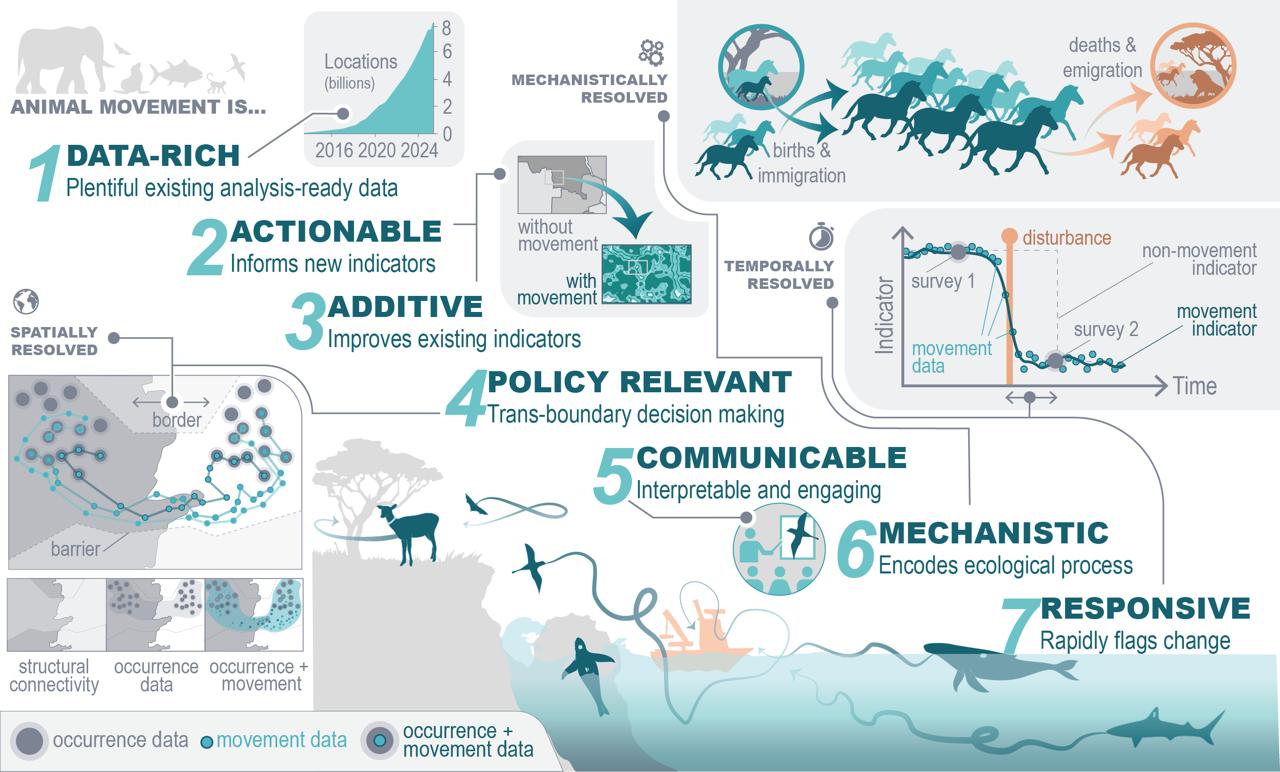
The publication marks an important milestone for Move BON and the broader movement ecology community. It demonstrates how animal movement data can strengthen biodiversity monitoring by providing dynamic, policy-relevant information that helps track and understand biodiversity change.
Read the paper: A call to integrate animal movement into biodiversity indicators in Nature Reviews Biodiversity. https://doi.org/10.1038/s44358-026-00173-x
Complimentary shared link: https://tinyurl.com/45ffbztu
About Move BON: Move BON is GEO BON’s global Biodiversity Observation Network dedicated to transforming movement insights into actionable evidence that supports international conservation policy and planning.